The emergence of 5G technology unlocks transformative opportunities for service innovation and smart city ecosystems, enabling advancements in areas such as the internet of things, remote operations, telemedicine and intelligent transportation systems. With the widespread deployment of 5G in Hong Kong, mobile users now benefit from enhanced services featuring high speed, high capacity and ultra-reliable connectivity.

5G coverage in Hong Kong has already exceeded 99%.
As of end March 2025, CA had assigned a total of 3 630 MHz of radio spectrum in various low, mid and high frequency bands, namely 700 MHz, 3.3 GHz, 3.5 GHz, 4.9 GHz, 6/7 GHz and 26/28 GHz for public mobile telecommunications use, including the provision of 5G services. Since the launch of commercial 5G services on 1 April 2020, as of end March 2025, 5G coverage in Hong Kong has exceeded 99%, covering all populated districts, major shopping malls and MTR stations.
To meet the growing demand for innovative 5G applications in terms of speed, capacity and coverage, OFCA supported CA in making available additional spectrum in different frequency bands to meet market demand. Following the spectrum auction held in November 2024, 300 MHz of spectrum in the newly introduced 6/7 GHz band was assigned to MNOs in March 2025 for the provision of public mobile communications services. The release of spectrum in the 6/7 GHz band, which is suitable for the current 5G and future 6G deployment, made Hong Kong the first mover in the release of relevant spectrum for future 6G development. OFCA also administratively assigned another 1 200 MHz of the non-shared spectrum in the 26/28 GHz band to MNOs for the provision of 5G or more advanced mobile services in August 2024.
The current assignments of 20 MHz of spectrum in the 850/900 MHz band and 90 MHz of spectrum in the 2.3 GHz band are set to expire in May 2026 and March 2027 respectively. Pursuant to the spectrum auction conducted in November 2024, the re-assignment of spectrum in the 850/900 MHz and 2.3 GHz bands will take effect in June 2026 and March 2027 respectively.
As announced in the 2024 Policy Address, the Government will continue to make available more suitable radio spectrum to the market in a timely manner to support a wider and more advanced applications of communications technology (including 6G). The current assignments of the remaining 50 MHz of spectrum in the 2.5/2.6 GHz band will expire in May 2028. OFCA supported CA and Secretary for Commerce and Economic Development in conducting a joint public consultation in September 2024 on the re-assignment arrangements as well as the related spectrum utilization fees. Pursuant to the above decision, the spectrum concerned is targeted to be re-assigned by way of auction in the fourth quarter of 2025.
To support the Government’s policy initiative to improve network coverage in remote areas, OFCA continued to implement the subsidy scheme with a funding of HK$770 million to provide financial incentives for fixed network operators (FNOs) to extend fibre-based networks to 235 villages across nine districts in the New Territories and outlying islands in phases by 2026, benefiting approximately 110 000 villagers.
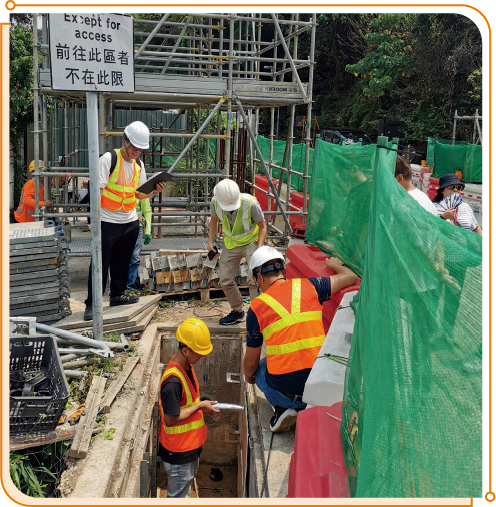
Staff members of OFCA together with representatives from the relevant FNO carrying out acceptance work on a telecommunications manhole installed under the Subsidy Scheme to Extend Fibre-based Networks to Villages in Remote Areas.
The 235 villages were grouped under six tender projects (namely, Project 1 to Project 6), which were awarded under the subsidy scheme between November 2019 and May 2020. Selected FNOs were entrusted to roll out fibre-based lead-in connections to the villages concerned, and lay three submarine fibre-based cables connecting Lamma Island to Hong Kong Island (under Project 5), as well as Cheung Chau to Lantau Island and Peng Chau to Lantau Island (under Project 6) respectively. To facilitate market competition, the selected FNOs are required to open up at least half of capacity of the network facilities and submarine fibre-based cables subsidised under the subsidy scheme for use by other FNOs free of charge.
As of March 2025, the selected FNOs have extended their fibre-based networks to over 220 villages and completed the rollout of the three submarine fibre cables connecting Lamma Island, Cheung Chau and Peng Chau. OFCA will continue to supervise the implementation of the subsidy scheme, and it is expected that fibre-based networks will be extended to all villages covered by the subsidy scheme by 2026.
With the extension of the fibre-based networks, not only will the villagers concerned be able to enjoy high-speed fixed broadband services, but MNOs will also be able to use the new networks as backhaul for their mobile networks, enabling the provision of high-speed and innovative mobile services, including 5G services, to the areas concerned.
Under the amended section 14 of the TO, which took effect on 1 October 2024 pursuant to the enactment of the Telecommunications (Amendment) Ordinance 2024, MNOs authorised by CA can access reserved space in specified buildings (including new and redeveloped commercial, industrial, residential and hotel buildings) with building plans approved on or after 1 April 2025, to install and maintain mobile communications facilities without paying a fee to the land owners concerned. In addition, new government buildings and public housing will also follow suit. The arrangement will help further expand the mobile network coverage and capacity in Hong Kong. OFCA assisted CA in the promulgation of the “Code of Practice for the Provision of Mobile Access Facilities in Specified Buildings for the Provision of Public Mobile Radiocommunications Services”, which sets out specific requirements for developers and MNOs regarding the installation of mobile communications facilities in specified buildings. OFCA will continue to support the administration of CA’s authorisation to MNOs under the amended section 14 of the TO and work closely with the Buildings Department and other relevant government departments to ensure unified implementation of the new arrangement.
Owing to the characteristics of 5G, more RBSs are required to be installed to provide comprehensive coverage. To facilitate the expedient and effective rollout of the 5G network, OFCA has, since March 2019, introduced the streamlined application procedure (SAP) to open up more than 1 500 suitable government premises for MNOs to install RBSs. OFCA has set up a dedicated team to coordinate with MNOs and relevant government departments to process applications under the SAP. OFCA issued the “Guidance Notes for Submission of Applications under the Pilot Scheme for Installation of Radio Base Stations at Selected Government Venues”, setting out the principles and requirements for submitting and processing applications via SAP. As an incentive for MNOs, a nominal rental of HK$1 per year is charged for each RBS installed. As of March 2025, 252 applications were received under the scheme, of which 139 were approved.
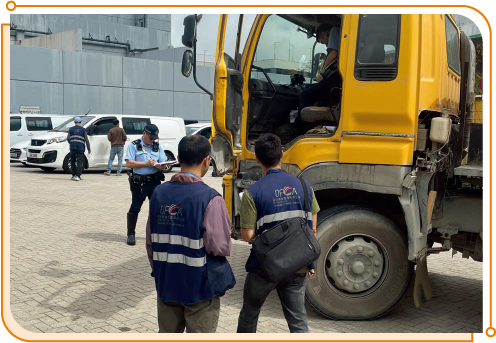
Staff members of OFCA conducting a roadblock operation to inspect the mobile radio station in vehicles.
Apart from government premises, the Government has established mechanisms to facilitate MNOs’ installation of RBSs at sheltered bus stops and public payphone kiosks. To facilitate MNOs’ access to these facilities, OFCA issued the “Guidelines on the Use of Public Payphone Kiosks for the Installation of Radio Base Stations for Provision of Public Mobile Services” and the “Guidelines on the Use of Sheltered Bus Stops for the Installation of Radio Base Stations for Provision of Public Mobile Services” in April and November 2020, respectively. As of March 2025, 15 applications for installation of RBS at sheltered bus stops and one application for installation at public payphone kiosks were approved. Moreover, the Government will reserve available space and loading capacity at multi-functional smart lampposts in various districts for RBS installation to further expand the 5G network coverage. OFCA will continue to work with the industry and relevant government departments in identifying suitable public facilities for RBS installation and facilitating technical trials.
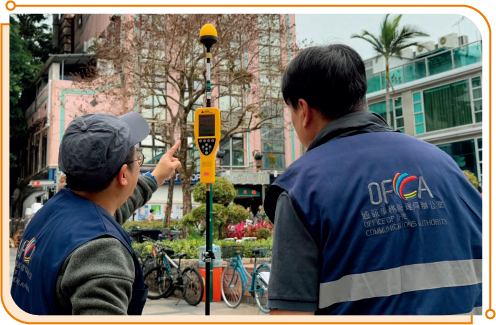
Staff members of OFCA conducting a non-ionising radiation measurement for the residents near RBSs.
The 2023 Policy Address announced that the Government would proactively coordinate with relevant organisations to enhance 5G network capacity at major public event venues. To implement this initiative, OFCA has been actively coordinating with relevant stakeholders, including government departments, venue managers and MNOs. As of March 2025, additional RBSs were installed to enhance 5G coverage and network capacity in major public event venues, including the Central Harbourfront Event Space, Hong Kong Coliseum, Hong Kong Convention and Exhibition Centre, AsiaWorld-Expo, Victoria Park and Kai Tak Sports Park. OFCA will continue to coordinate with relevant organisations to enhance mobile communications facilities at major event venues to ensure that the public and event participants can enjoy quality communications services and to provide high-level telecommunications infrastructure that reinforces Hong Kong’s position as an international hub for mega events.
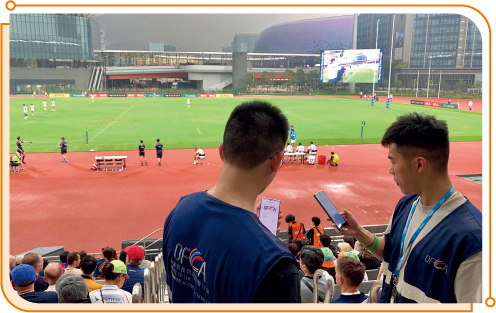
Staff members of OFCA conducting a measurement on 5G network performance during a rugby test event at the Youth Sports Ground of Kai Tak Sports Park.
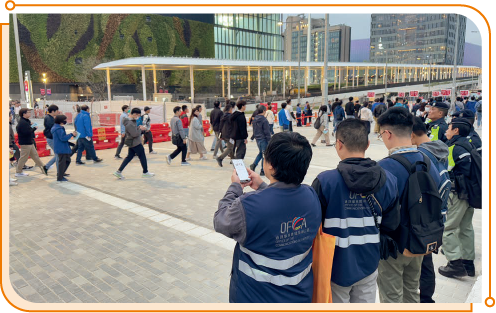
Staff members of OFCA monitoring 5G performance when spectators leaving Kai Tak Sports Park in a stress test event.
The 2023 Policy Address announced that the Government would enhance 5G coverage by expediting the expansion of mobile network infrastructure in rural and remote areas through subsidies. To take forward the initiative, OFCA completed the industry and local consultations on the proposed framework and site locations for a subsidy scheme to extend 5G coverage in rural and remote areas. The subsidy scheme will provide financial incentive to MNOs to encourage them to install RBSs at about 50 sites to enhance mobile network coverage in country parks, outlying islands, and other rural and remote areas, with a view to improving the quality of life in these areas and safeguarding the safety of rural activities.
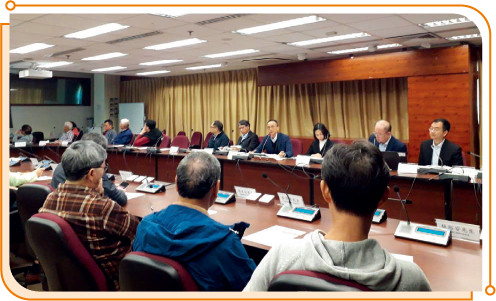
Staff members of OFCA introducing the proposed framework for the Subsidy Scheme to Extend 5G Coverage to Rural and Remote Areas to the Rural Committees of North District.
Upon approval of the relevant funding (around HK$150 million) by the LegCo, OFCA will launch the subsidy scheme in July 2025. Application guidelines, setting out detailed procedures for MNOs to submit applications for subsidy under the scheme and MNOs’ obligations, will be issued. OFCA will closely monitor the implementation of the subsidy scheme. It is expected that all RBSs under the subsidy scheme will be installed and put into service progressively within four years after the launch of the subsidy scheme.
Following the reallocation of the 3.4 – 3.6 GHz (3.5 GHz) band from fixed satellite service to mobile service with effect from 1 April 2020, two restriction zones in Tai Po and Stanley were delineated to ensure the coexistence of 5G services and the earth stations for telemetry, tracking, and control of the licensed satellites in orbit (TT&C stations) operating in the same and adjacent bands. With OFCA’s assistance, one satellite operator has been granted a land lot for relocating its TT&C stations in the 3.5 GHz band from Tai Po to the Teleport, while another satellite operator has undertaken to install satellite band-pass filters at its satellite facilities to prevent radio interference. As the relocation of the TT&C stations was completed in October 2024, the “3.5 GHz restriction zone” in Tai Po was lifted with effect from 31 October 2024.
OFCA has kept up with worldwide development trends in telecommunications and participates in related international/regional meetings of the ITU, Asia-Pacific Telecommunity, and other organisations. OFCA has also maintained close dialogue with industry players in Hong Kong to keep abreast of the development of the telecommunications industry. OFCA assisted CA in allocating additional frequency bands to relevant radiocommunications services in Hong Kong in accordance with the outcomes of the World Radiocommunication Conference of the ITU in 2023. In addition, based on OFCA’s recommendations, CA will issue the Spectrum Release Plan for 2025 to 2027 in July 2025 to inform the industry of the potential supply of spectrum for the provision of public mobile and/or other radiocommunications services over the next three years. Taking note of market developments, OFCA will continue to assist CA in ensuring the timely supply of additional spectrum to the industry.

Staff members of OFCA investigating a radio interference incident.
Pursuant to the Telecommunications (Registration of SIM Cards) Regulation (Cap. 106AI), the RNR Programme has been fully implemented since February 2023. It requires that all SIM cards issued and used locally (including SIM service plans and PPS cards) must complete real-name registration before service activation. CA has issued the “Guidelines on Implementation of Real-name Registration for SIM Cards” (the RNR Guidelines) to provide guidance and detailed requirements of the RNR Programme for TSPs.
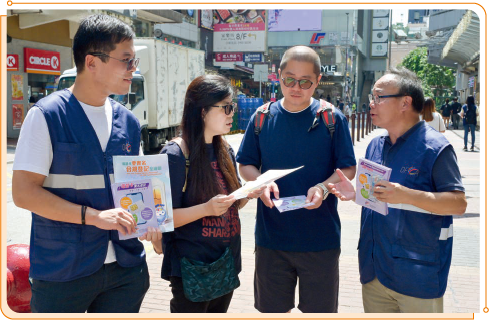
OFCA and the Digital Policy Office jointly conducted a publicity and education activity on the RNR Programme in Mong Kok on 27 September 2024 to remind members of the public not to purchase registered PPS cards.
Since the full implementation of the RNR Programme, OFCA has carried out ongoing monitoring and enforcement actions to ensure that TSPs and other relevant parties comply with the requirements of the Telecommunications (Registration of SIM Cards) Regulation (Cap. 106AI) and the RNR Guidelines. OFCA has worked with TSPs, reminding them to enhance their registration platforms and strengthen the inspection of registration records. Among others, they have adopted “iAM Smart” as the default registration method for Hong Kong identity card holders in completing real-name registration of PPS cards starting from 1 October 2024. For PPS cards with registration made by non-HKID holders via the online registration platform, TSPs will conduct manual checking to verify the authenticity of the identification documents of the users after their completion of RNR. If any registration of PPS cards are found to be non-compliant with the regulatory requirements (e.g. suspected use of forged documents for registration), the relevant PPS cards will be deactivated by TSPs.
OFCA will continue to work with TSPs to conduct sample checks on registration information to safeguard the integrity of the registration records. OFCA will continue enforcement and monitoring actions, including verification of TSPs’ registration platforms, ad hoc market surveillances, and inspection of registration records. Ongoing publicity efforts will also be arranged to raise public awareness of the requirements of the RNR Programme.
OFCA is providing support to CEDB in reviewing the implementation of the RNR Programme, with a view to introducing the relevant legislative amendments into LegCo for scrutiny. Subject to the legislative proposals, we will also revise the relevant guidelines, mount the publicity campaign as well as work closely with the enforcement agencies and TSPs to ensure smooth implementation of the strengthened RNR Programme.
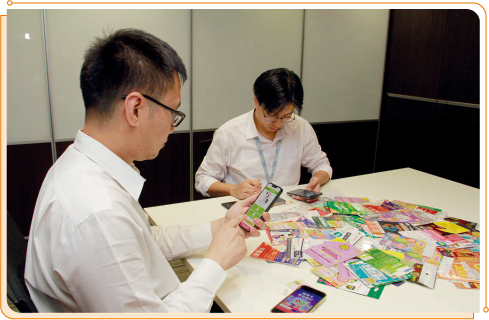
Staff members of OFCA conducting a regular check on the RNR Programme platforms provided by TSPs.
OFCA has been working closely with the telecommunications industry and the Police to devise and implement a variety of technical measures against fraudulent calls and messages delivered through telecommunications networks. Since 2023/24, the telecommunications industry has implemented measures to block suspicious calls prefixed with “+852” originating from outside Hong Kong, as well as to send voice or text alerts to mobile service users before receiving such calls prefixed with “+852”. As of March 2025, TSPs had blocked about 5.3 million suspicious calls prefixed with “+852”, and mobile service providers had issued more than 30 million “+852” voice or text alerts.
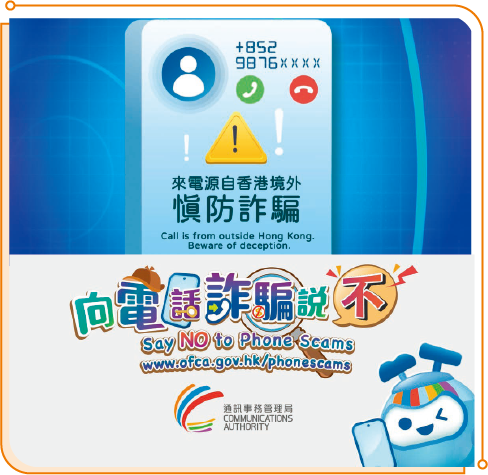
OFCA launched short videos to remind the public of staying vigilant against suspicious calls.
Besides, OFCA formulated a code of practice requiring TSPs to monitor calls and SMS originating from their networks since end June 2023 and August 2024, respectively. Should call or SMS patterns indicate suspected phone deception, the services of the relevant telephone numbers will be suspended. As of March 2025, about 1.4 million local telephone numbers had been suspended in accordance with the code of practice. OFCA also issued a code of practice in October 2024 to provide practical guidance to TSPs for promulgating anti-scam messages to subscribers of public telecommunications services in Hong Kong through their publicity channels and means.
To further assist the public in staying vigilant against suspicious calls, starting from 31 December 2024, when local mobile and fixed services users answer calls from newly activated mobile PPS cards, mobile service providers will first play a voice alert stating “Call made from a new pre-paid SIM card” in Cantonese and Putonghua before connecting the call. As of March 2025, mobile service providers had played about 14.8 million voice alerts.
To help the public verify the authenticity of SMS senders, OFCA collaborated with the telecommunications industry, the banking industry and the Police to establish the SMS Sender Registration Scheme. Under the scheme, Registered Senders must use Registered SMS Sender IDs with the prefix “#” to send SMS messages to local mobile service subscribers.

The SMS Sender Registration Scheme has opened for application by all sectors starting from February 2024.
All other SMS messages sent via mobile service providers in Hong Kong with sender IDs containing “#” but not sent by Registered Senders will be blocked by the telecommunications networks. The scheme has been implemented since 28 December 2023, and was open for application by all sectors starting from February 2024. Major TSPs, banks, government departments, statutory bodies, companies and organisations from various sectors (e.g. public utilities, retail, education, insurance and credit finance, etc.) have joined the scheme progressively. As of March 2025, more than 490 companies and organisations had participated in the scheme. OFCA will continue to publicise the scheme and encourage more industries and organisations to join.
LegCo passed the Protection of Critical Infrastructures (Computer Systems) Bill on 19 March 2025. The Ordinance aims to implement the 2023 Policy Address initiative to legislate for cybersecurity of critical infrastructure, under which CA is being specified as the designated authority for the telecommunications and broadcasting sectors. The Protection of Critical Infrastructures (Computer Systems) Ordinance (Cap. 653) will come into operation on 1 January 2026. OFCA will support CA on the implementation arrangements of the Ordinance.
With the support of OFCA and other government departments, PCCW-HKT Telephone Limited and Hong Kong Telecommunications (HKT) Limited launched a trial of smart payphone kiosks (Smart Kiosks) in March 2023 to revitalise traditional kiosk-type public payphones. Two trial Smart Kiosks were installed in Causeway Bay and Central in April and May 2023, respectively. Apart from public payphone and free WiFi services, the Smart Kiosks also provide information services such as transportation and nearby public facilities, contact information for social welfare services, tips for caregivers, and news and weather updates, as well as a USB charging port available to the public free of charge. OFCA will continue to provide coordination support for the trial.
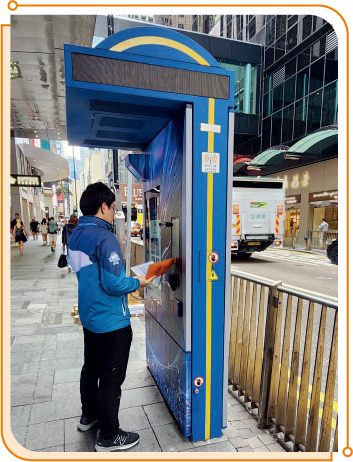
A staff member of OFCA testing Smart Kiosk services in Central.
Along with the ongoing network expansion of FNOs, Hong Kong has achieved a high level of broadband service penetration. As of March 2025, there were around three million residential and commercial fixed broadband subscriptions, with a household penetration rate exceeding 97%. Among these, around 87% of households were enjoying fixed broadband services via optical fibre. In particular, over 71% of households were using fixed broadband services at the speed of 1 Gbps or above.
According to a report issued by the Fibre to the Home Council Europe in March 2025, among the 86 economies under comparison, Hong Kong ranked fifth worldwide in fibre-to-home/building household penetration.
Being a major regional telecommunications hub with sound and excellent external telecommunications infrastructure, Hong Kong has 12 submarine cable systems and operates 10 satellites for external communications. OFCA has been facilitating operators in obtaining statutory approvals for the laying and landing of new submarine cable systems in Hong Kong from relevant government departments. With the support of OFCA’s single-point-of-contact service, several new regional and transcontinental submarine cable systems are under construction and are scheduled to be put into service between 2025 and 2029.
OFCA has been providing technical support and advice to the Government on assessing the use of sites granted for telephone exchanges and other telecommunications-related facilities.
To align with the Government’s policy to improve regulatory measures with a view to enhancing Hong Kong’s competitiveness, OFCA supported CA in enhancing the licensing regime for four types of licences, namely Ship Station Licence, Broadcast Radio Relay Station Licence, Hotel Television (Transmission) Licence and Satellite Master Antenna Television Licence, by extending the validity period of these licences from one year to two years. This change aims to enhance regulatory certainty for the licensees. This two-year licensing arrangement took effect from March 2024. OFCA will extend this arrangement to other types of licences issued under the TO in 2025 to 2026.
Since satellite spectrum and orbital positions are scarce and invaluable resources, their use by communications satellites should comply with the coordination and notification requirements of ITU. OFCA supports satellite operators in coordinating with foreign administrations and assists in processing licences for the operation of satellites in space orbits. As of end March 2025, three satellite operators were licensed in Hong Kong to track, control and conduct telemetry for a total of ten geostationary satellites in orbit.
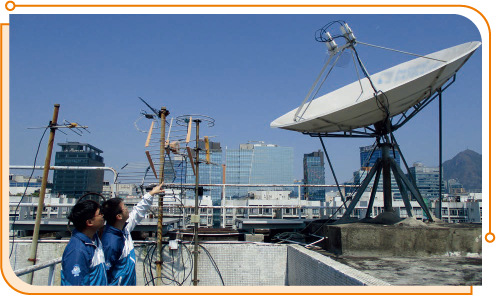
Staff members of OFCA conducting an inspection on SMATV systems.
OFCA keeps abreast of international developments in telecommunications standardisation and updates local technical standards in order to meet the needs of the industry and the public. In 2024/25, one new technical standard and three revised technical standards – governing RBSs for public mobile services, WiFi equipment and radiation safety of wireless devices – were approved and issued by CA.
Qualified local and overseas testing laboratories now provide testing and certification services for various types of telecommunications equipment in accordance with technical standards prescribed by CA. In particular, a full range of telecommunications equipment testing and certification services is offered by local laboratories accredited by CA as local certification bodies (LCBs). In 2024/25, LCBs and foreign certification bodies issued 630 equipment certificates to meet the needs of the telecommunications equipment market.
To ensure that all LCBs providing telecommunications equipment testing and certification services meet the required service quality and performance standards, OFCA will continue to closely monitor their performance through regular documentary checks, on-site visits and reviews. So far, all LCBs have complied with the requirements set by OFCA.
Under current statutory requirements in Hong Kong, satellite operators are required to obtain the Outer Space Licence (OSL) issued by the Chief Executive under the Outer Space Ordinance (Cap. 523) and the Space Station Carrier Licence (SSCL) issued by CA under the TO for each satellite operated in Hong Kong. Since LEO satellites are operated in constellation that comprising tens or hundreds of LEO satellites, there is a need to consider how the licensing arrangements will be formulated based on the actual circumstances of LEO satellites.
The 2024 Policy Address and the 2025-26 Budget announced that the Government would conduct a study on streamlining the vetting procedures of licence applications for operating LEO satellites. The aim is to enhance Hong Kong’s attractiveness and competitiveness in the global satellite communications market. OFCA has been assisting CEDB in completing the study by 2025.
LAE, which refers to economic activities taking place in airspace below 1 000 metres, is creating new possibilities in areas such as aerial surveillance, drone delivery, terrain mapping and building inspection. Under the 2024 Policy Address, the Government has established the WG to formulate development strategies and inter-departmental action plans, starting with projects on low-altitude applications. OFCA actively participated in the WG and contributed from the telecommunications perspective to support the development of LAE.
Among the various infrastructure facilities, public mobile network is an indispensable part for promoting low-altitude flying activities. At present, unmanned aircrafts for aerial photography or performances can generally use the shared 2.4 GHz and 5 GHz bands assigned for wireless local area networks, or the fourth generation (4G) or 5G mobile networks for remote control, data transmission, and positioning purposes. OFCA will continue to closely monitor telecommunications market developments in the Mainland and worldwide, including the designation of dedicated spectrum bands for the exclusive use by UAS, so as to ensure that the spectrum planning in Hong Kong aligns with the Mainland and other advanced economies, thereby promoting the development of LAE activities in Hong Kong.