
The Competition Ordinance (Cap. 619) (CO) provides a cross-sectoral competition law prohibiting anti-competitive conduct in all sectors. Under the CO, CA is conferred concurrent jurisdiction with the Competition Commission to enforce the CO in respect of the conduct of undertakings operating in the telecommunications and broadcasting sectors, including merger and acquisition activities involving carrier licensees in the telecommunications sector.
Pursuant to the memorandum of understanding signed by CA and the Competition Commission, CA will ordinarily assume the role of lead authority for matters falling within the concurrent jurisdiction. For matters involving issues that are partly within and partly outside the concurrent jurisdiction, CA and the Competition Commission will discuss and agree on the best arrangement for handling the matter on a case-by-case basis.
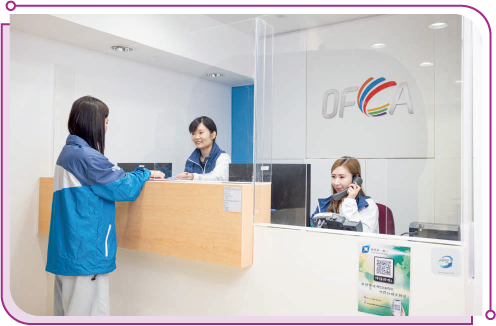
Staff members of OFCA handle public enquiries and complaints related to broadcasting and telecommunications matters in writing, through email and hotline.
From 1 April 2024 to 31 March 2025, a total of 18 complaints and enquiries were received under the CO, all of which were closed without the need for further action.
During the year, OFCA also assisted CA in reviewing two transactions under the merger rule of the CO. The reviews are currently in progress.
The fair trading sections of the Trade Descriptions Ordinance (Cap. 362) (TDO) prohibit certain specified unfair trade practices by traders in the provision of goods and services to consumers.
CA is conferred concurrent jurisdiction with the Customs and Excise Department to enforce the fair trading sections of the TDO regarding the commercial practices of licensees under the TO and the Broadcasting Ordinance (Cap. 562) that are directly connected with the provision of telecommunications and broadcasting services. The two enforcement agencies have entered into a memorandum of understanding to coordinate the performance of their functions under the fair trading sections of the TDO and have issued a set of enforcement guidelines to provide guidance for traders and consumers on the operation of the fair trading sections.
From 1 April 2024 to 31 March 2025, OFCA handled a total of 297 complaint cases under the TDO. Among these, 233 cases were closed due to insufficient evidence to establish a contravention or because they fell outside the scope of the TDO. Four cases were closed after CA issued advisory letters to the licensees concerned, drawing their attention to the subject matter and providing advice on improving their relevant commercial practices in relation to the sale, supply or promotion of telecommunications or broadcasting services to consumers. The remaining 60 cases were under processing.
CA has established three Do-Not-Call (DNC) Registers – for facsimile messages, short messages and pre-recorded telephone messages – under the Unsolicited Electronic Messages Ordinance (Cap. 593) (UEMO). No commercial electronic messages (CEMs) shall be sent to registered telephone numbers unless the senders have obtained consent from the registered users. As of March 2025, these DNC Registers contained more than 2.8 million telephone numbers. In addition to refraining from sending CEMs to the registered telephone numbers on the DNC Registers, senders of CEMs are also required under the UEMO to comply with a number of rules. For example, they must provide the recipients with their contact information and an “unsubscribe facility” in their CEMs so that the recipients can contact the senders and unsubscribe from receiving their CEMs.
In 2024/25, OFCA received 553 reports regarding suspected contraventions of the UEMO, a decrease of about 20% from the previous year. A majority of these reports were related to pre-recorded telephone messages and short messages. OFCA will continue to monitor compliance and streamline procedures for more effective enforcement.
OFCA will take enforcement actions on cases suspected of contravening the UEMO. Generally speaking, for cases where the number of reports received against a sender is below a certain threshold, OFCA will issue an advisory letter reminding the sender to observe the requirements under the UEMO. In cases where the number of reports received against a sender exceeds the threshold, or if OFCA continues to receive reports against the same sender after the issuance of advisory letter, OFCA will conduct formal investigation and may issue a warning letter to the sender. In 2024/25, a total of 51 advisory letters and 11 warning letters were issued. Cases in which senders of CEMs rectified their breaches after receiving advisory or warning letters were not subject to further enforcement actions, such as the issuance of enforcement notices to the senders of CEMs.

In the event of repeated contraventions by a sender of CEMs, CA may issue an enforcement notice in accordance with section 38 of the UEMO, directing the sender to take steps to remedy the contravention. In 2024/25, a total of two enforcement notices were issued. Anyone who fails to comply with an enforcement notice may be liable to a fine of up to HK$100,000 on first conviction.
To strike a balance between the need for business operation and minimising nuisance that may be caused by marketing calls, the Government has adopted a pragmatic and effective approach by actively collaborating with trade associations across different industries to manage marketing calls.
Since 2010, the Government has encouraged trade associations of four industries, namely, finance, insurance, telecommunications and call centres to implement an industry scheme for managing marketing calls, with a view to minimising the inconvenience to the public. Since 2011, these associations have issued their codes of practice with reference to the Benchmark Code of Practice on Person-to-Person Marketing Calls (Benchmark CoP) formulated by the then Office of the Telecommunications Authority.
To further expand and strengthen the industry regulation of marketing calls, OFCA revised the Benchmark CoP in April 2024 with enhancements such as requiring telemarketers to provide their names and contact numbers upon recipients’ requests, as well as limiting the number of calls made by telemarketers to the same telephone number within a specific timeframe.
Apart from the four existing sectors, OFCA also invited three new sectors, namely beauty, estate agencies and money lenders, to join the enhanced scheme. Since June 2024, a total of 12 trade associations from these seven sectors have participated in the enhanced scheme and issued their respective codes of practice with reference to the revised Benchmark CoP issued by OFCA.
To safeguard consumer interests in the use of telecommunications services, OFCA takes proactive actions to implement various consumer protection measures and works with the industry to draw up and implement self-regulatory measures for addressing emerging consumer issues from time to time.
These measures include the voluntary Customer Complaint Settlement Scheme (CCSS) administered by the Communications Association of Hong Kong representing the industry. The CCSS aims to help resolve billing disputes in deadlock between TSPs and their customers through mediation.

OFCA promotes CCSS to the public.
Other self-regulatory measures voluntarily implemented by the industry include the promulgation of the Code of Practice for Telecommunications Service Contracts, which aims at improving the clarity of provisions in the telecommunications service contracts as well as the Code for the Provision of Chargeable Mobile Content Services, which governs the practices of third-party content service providers.
Other examples include the implementation of mobile bill shock preventive measures and the publication on OFCA’s website of the arrangements adopted by major residential broadband service providers for handling service termination requests from consumers.
OFCA will continue to monitor the implementation and effectiveness of the various consumer protection measures adopted and, where necessary, engage the industry to seek further enhancement of the existing measures or introduce new ones.
Since December 2010, OFCA has been providing a broadband performance test system which enables broadband service users to measure the performance of their broadband connections, including download and upload speeds, network latency, packet loss and jitter. Apart from users of desktop and notebook computers, users of smart phones and tablets running iOS and Android operating systems may also make use of the test system.
From the launch of the service to March 2025, about 129 million broadband performance tests were conducted with the use of the system. We will continue to monitor the technology and market developments for provision of the test service.
OFCA continued its multi-faceted publicity efforts during the year through the launch of the annual Consumer Education Campaign (Campaign). Under the theme “Say NO to Phone Scams”, the Campaign aimed to enhance public vigilance against telephone and SMS scams. As the highlight of the Campaign, a Fun Day cum Exhibition (Fun Day) was held on 23 and 24 November 2024 at Kowloon Park, featuring interactive game booths, quiz contests, family workshops, informative exhibits, and educational videos. The award presentation ceremony for the “Beware of Phone and SMS Scam Poster and Slogan Design Competition” was also held at the Fun Day to present awards to the winners. The competition, aiming at raising primary students’ awareness of anti-phone scam messages, received over 2 900 entries from a total of 113 primary schools. Other activities under the Campaign included mini exhibitions, community and school talks, as well as roving drama performances for schools to remind the public to stay vigilant against telephone and SMS scams.

To raise public vigilance against and awareness of telecommunications scams, CA organised the large-scale “Say NO to Phone Scams” Fun Day cum Exhibition at Kowloon Park on 23 and 24 November 2024.

The award presentation ceremony for the “Beware of Phone and SMS Scam Poster and Slogan Design Competition” was held at the Fun Day to present awards to the winners.
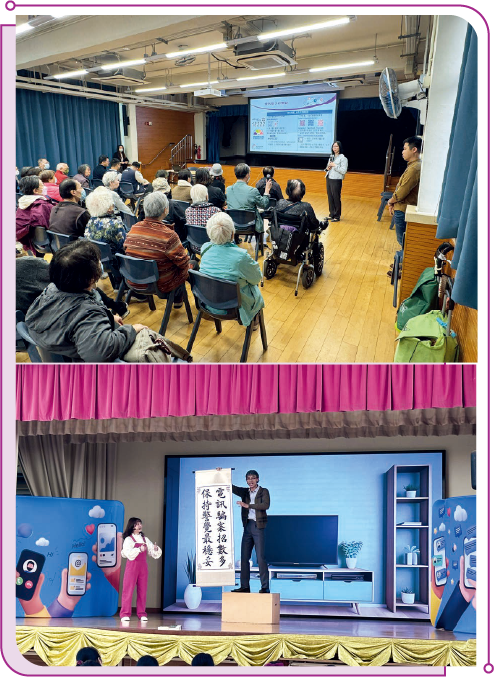
OFCA actively organises the Consumer Education Campaign every year to enhance public knowledge of smart use of communications services. The activities include community talks, roving drama for schools, school talks and mini exhibitions.
To tie in with the theme of the Campaign, OFCA produced two new one-minute animated short videos, namely “Say No to Phone Scams” and “Say No to SMS Scams”, to promote OFCA’s anti-phone scam measures and encourage the public to use call-filtering apps. In addition, two new sets of television and radio announcements in the public interest (APIs) under the themes “Use Your Original Identity Document for SIM Card Registration” and “Pay Attention to Alerts. Be Cautious with Suspicious Calls.” were produced in July 2024 and January 2025 respectively. The first set of APIs reminds the public to complete SIM card registration with their own original identity documents, while the second one aims to promote to the public the implementation of voice alerts for newly activated PPS cards.

During the year, OFCA launched two new sets of APIs to promote the implementation of voice alerts for newly activated PPS cards, and use of original identity document for SIM card registration.
To further strengthen publicity efforts on the promotion of anti-phone scam messages, OFCA launched the District Anti-Phone Deception Ambassador Scheme (Ambassador Scheme) in mid-January 2025 by inviting District Council (DC) Members and staff members of their ward offices from all 18 districts in Hong Kong to participate and help promote the messages to the public at the community level. Over 150 DC Members’ ward offices supported the initiative, with more than 300 DC Members and their staff members joining the Ambassador Scheme as District Anti-Phone Deception Ambassadors (Ambassadors). The launch ceremony of the Ambassador Scheme was held on 16 January 2025, followed by an anti-deception information seminar to introduce to the Ambassadors the measures implemented by OFCA to combat telephone scams and to provide them with information related to anti-phone scam messages. OFCA also provided the participating DC Members’ ward offices with anti-phone scam promotional leaflets and souvenirs for distribution to the public through their community activities and daily contacts with residents in their districts. OFCA will continue to collaborate with the Ambassadors through the conduct of roadshows and other promotional activities in 2025/26 to sustain and strengthen its anti-phone scam publicity efforts.
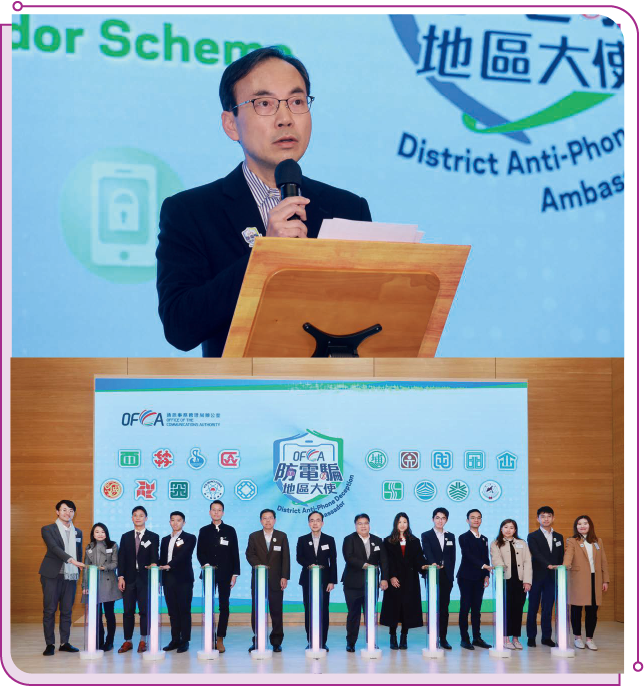
OFCA held the Launch Ceremony of the District Anti-Phone Deception Ambassador Scheme on 16 January 2025. Mr Chaucer Leung, Director-General of Communications, officiated at the launch ceremony with DC Chairmen and representatives.

Over 300 DC members and staff members of their ward offices from all 18 districts in Hong Kong were appointed as District Anti-Phone Deception Ambassadors to assist in the promotion of anti-phone scam messages at the community level.